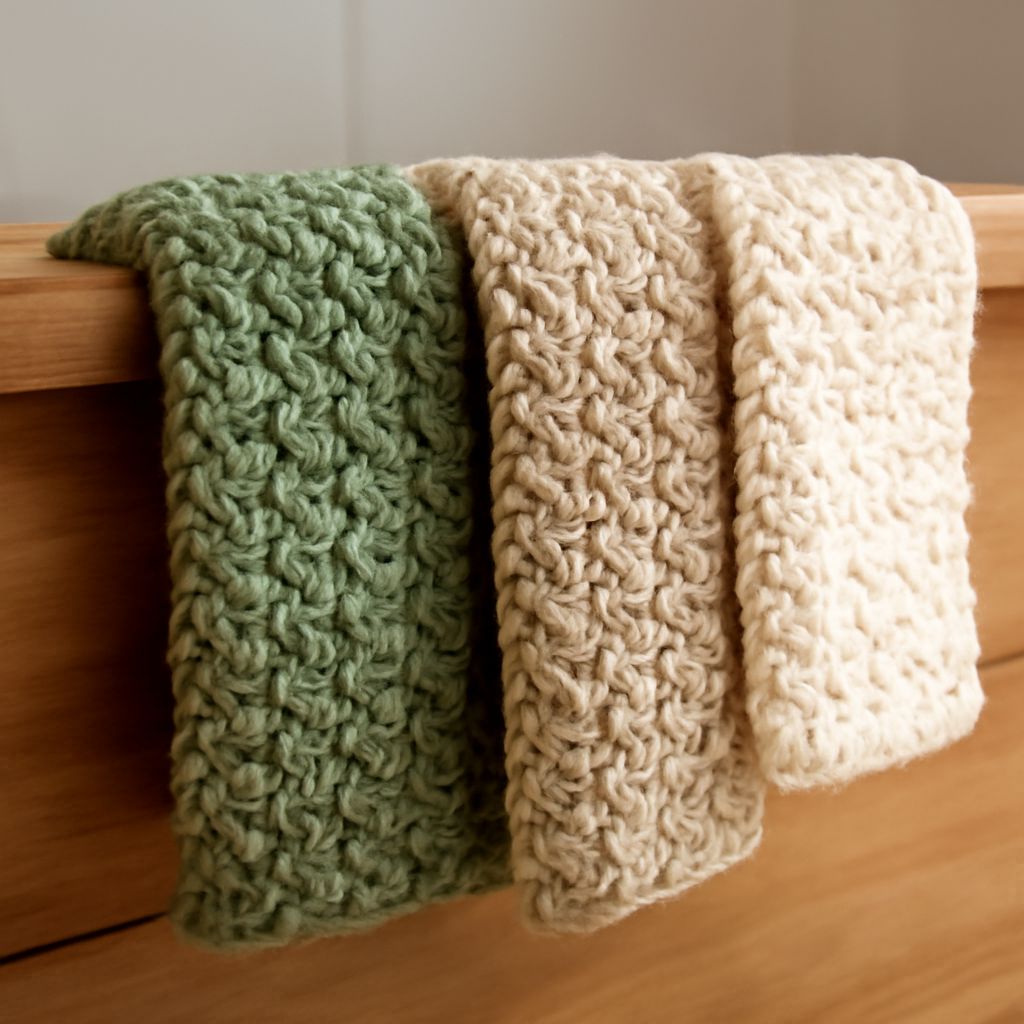
How can a beginner make a useful kitchen cloth with one hook and a few basic stitches? A square worked in single crochet offers a straightforward answer: its rows are easy to count, its texture is firm, and its size can be adjusted as the work grows.
The free dishcloth instructions below use U.S. crochet terms and ordinary cotton yarn. They form one complete project, while a separately linked Tunisian version offers a different method of building fabric. Both approaches can be adapted to the hand and the task by checking the sample before committing to a full cloth.
Crochet Dishcloth Pattern Free to Follow
A crochet dishcloth pattern free to use can turn cotton yarn into a practical square. This easy crochet dishcloth pattern uses chains and single crochet throughout. For a crochet dishcloth, free pattern instructions should specify a stitch count at the end of each row; here that count is 30. A turning chain raises the yarn to the height of the next row and does not count as a stitch in this project.
Materials: approximately 70 yards of medium-weight, 100% cotton yarn; a 5 mm (U.S. H-8) crochet hook; scissors; and a yarn needle. The yardage is an estimate, so keeping a little extra is helpful. The example aims for a roughly 8-inch square, but the finished size depends on tension. Cotton intended for kitchen use is absorbent and washable; consult the yarn label for care.
Abbreviations: ch = chain; sc = single crochet; st = stitch. To make a chain, yarn over the hook and pull through the loop already on it. For a single crochet, insert the hook into the indicated stitch, yarn over and pull up a loop, then yarn over and pull through both loops on the hook.
- Foundation: Make a slip knot and ch 31. The loop on the hook is not counted as a chain.
- Row 1: Insert the hook into the second chain from the hook. Work 1 sc there and 1 sc in each remaining chain. The row has 30 sc. Ch 1 and turn.
- Row 2: Work 1 sc under both top loops of each stitch across, including the final stitch at the edge. Count 30 sc. Ch 1 and turn.
- Repeat: Continue Row 2 until the piece is approximately as tall as it is wide, ending after a completed row. Keep 30 sc in every row. A piece close to 8 inches wide may need roughly 30–36 rows, depending on gauge.
- Finish: Cut the yarn, leaving a tail of about 6 inches. Pull it through the final loop and tighten gently. Thread the yarn needle and weave both tails back through several stitches in different directions, then trim the excess.
This crochet dish cloth pattern requires no border. For comparison, Yarn and Spoon’s free beginner pattern also starts with 31 chains and works 30 single crochet stitches across. Its instructions may differ in finishing details; follow one set consistently when counting edges.
Adjust Size, Texture, and Edge
To check gauge, work a sample wider than 4 inches, lay it flat, and count the stitches across the middle 4 inches without stretching. If the fabric is too stiff for comfortable use, make another sample with a larger hook; if it is too open, try a smaller one. Record the width before choosing a starting chain.
For this stitch, start with one more chain than the desired number of stitches. For example, 26 chains produce 25 single crochet stitches in the first row. Continue until the height equals the measured width. The cloth can be rectangular instead: stop sooner for a shorter piece, or add rows for a longer one.
The plain edge shows the little turns at the end of each row. For a neater outline, work one optional round of sc around the outside, spacing stitches evenly along the sides and placing 3 sc in each corner. Join with a slip stitch to the first border stitch and fasten off. If the border ripples, remove some side stitches; if it draws the edge inward, add a few. A simple crochet dishcloth need not have a border to function.
Among crochet dishcloth patterns free of charge, some use medium-weight cotton to make a sturdy cloth with visible ridges. Thinner cotton and a smaller hook can make lighter fabric, with adjusted stitch and row counts. Among easy crochet dishcloth patterns, the choice of stitch also changes texture: single crochet gives a relatively compact surface, while a more open stitch allows more space between loops.
A Separate Tunisian Option
A tunisian crochet dishcloth is worked differently: stitches are gathered onto the hook in a forward pass and worked off in a return pass. The fabric is not turned after each row in the same way as the square above. A long Tunisian hook or cabled hook holds the accumulated loops; a larger hook may create a more flexible fabric.
Yarnspirations’ free Tunisian Simple Stitch Dishcloth provides a separate pattern. Check its materials, hook size, gauge, and finishing directions before starting rather than substituting its row count into the ordinary single-crochet instructions. For dishcloth crochet patterns in either technique, cotton is washable; follow the selected yarn’s care label.
Use and Troubleshoot the Cloth
A crocheted dishcloth should be rinsed after use and allowed to dry between uses. Wash it according to the yarn label, and avoid using a delicate decorative yarn for a cloth expected to withstand repeated cleaning. A tight stitch makes a firmer surface, while a looser fabric can be easier to fold around a glass or plate.
Count turning chains as directed by the chosen instructions: conventions differ between patterns.
If the square narrows into a trapezoid, a stitch has often been missed at the edge. Count all 30 stitches after each row, mark the first and last stitches, and insert the hook into the last stitch before making the turning chain. Undo the affected row and work it again with the full count.