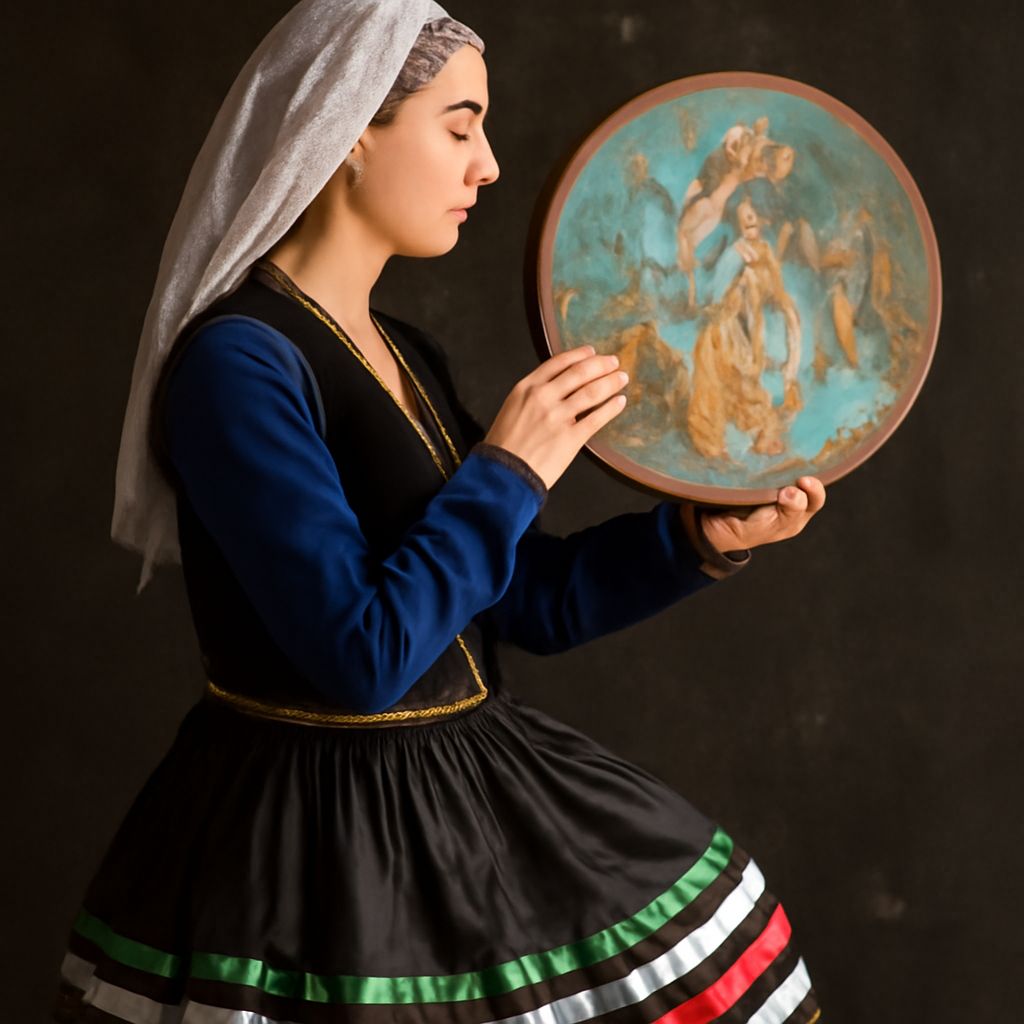
In a Safavid court painting, the edge of a long robe can reveal another color beneath it: a chemise and loose trousers form separate layers. This detail opens a way into clothing from Iran as a history of particular garments and settings. Traditional dress associated with Persia includes courtly silk, regional embroidery, and later designs that brought those practices into new settings.
Persian Traditional Dress: Read the Label First
Iranian clothing cannot be reduced to one national costume. Iran contains many communities and regional practices, and the word “Persian” may refer to a language and cultural tradition, a historical context, or an older geographical designation. An object’s date, place, maker, and intended use make those broad terms more precise.
For Persian traditional dress, a museum photograph of a surviving garment gives evidence of construction and material; a painting shows an artist’s representation of an ensemble. Both have limits. A jacket in a collection may be separated from the clothes once worn with it, and a court painting is not a record of everyone’s daily wardrobe. The examples below use each source for the details it can support.
Safavid Court Layers, Sixteenth to Seventeenth Century
The Metropolitan Museum of Art’s illustrated study of Safavid fashion describes early court images in which women and men wear long outer robes over a chemise, or pirahan, and loose ankle-length trousers. In the paintings, an outer robe may cross at the front and fasten at one side or open down the center. A belt gathers the layers, and contrasting colors allow the garments beneath to remain visible.
That combination gives one historically specific example of traditional Persian dress. It also shows why a robe should be read as part of an ensemble: its outline changes when it is belted, and the lower edge can expose the trousers underneath. The Met’s account draws on manuscript paintings and travelers’ descriptions, so its evidence is particularly relevant to courtly representation rather than to every household in Safavid Iran.
The same study describes clothing around 1600 in paintings by Riza-yi ‘Abbasi, with loose layers and patterned fabrics. Women’s headwear could include a square cloth called a chahar-qad, secured with a silk ribbon. The museum also identifies silk textiles with floral or figural designs and notes the use of gold- and silver-wrapped threads. These details help distinguish fabric, head covering, and fastening when examining an image of historic Persian attire.
Later in the Safavid period, the Met describes a change toward more fitted outer garments. A woman’s jacket could have close sleeves and a shaped waist, with a skirt that flared or rounded over the hips. The underlying chemise and trousers remained part of the described ensemble. Comparing the earlier loose layers with this fitted outline reveals change over time within the same dynasty.
An Iranian Jacket in the Nineteenth Century
The Met’s nineteenth-century jacket made in Iran, object C.I.59.18.3, offers a view of an actual garment. Its catalog identifies silk, cotton, and wool and classifies it as womenswear. The image allows the viewer to study the piece as an object: its opening, sleeves, and decorative surface can be inspected independently of a painted figure.
This item is evidence of Iranian clothing in a particular century, but its catalog does not identify a specific wearer, region, or occasion. Those missing details should remain open. The textile list also does not by itself establish which fiber appears in each visible section. Looking closely at this jacket alongside the Safavid images helps separate what can be seen from what a label or contextual source actually confirms.
Baloch Dress Fronts From Southeastern Iran
Regional examples bring a different scale of detail. The Spurlock Museum’s Baloch collection lists an Iranian Baluchistan dress-front fragment, 1995.24.0061, and a bodice, 1995.24.0062, both recorded as purchased in 1956. Their catalog images let readers examine decorated sections rather than a complete outfit. The purchase date is not necessarily the date of manufacture.
For context, Encyclopaedia Iranica’s account of Baluch clothing in Iran describes embroidered panels on women’s garments, including a broad bodice and a long front panel, with additional decoration at cuffs. It also describes a long garment worn with trousers and a headscarf. The account notes regional differences in pattern and color; it should be read as context for the collection objects, not as proof of the missing pieces of either individual garment.
In this regional tradition of Persian and Iranian dress, the position of embroidery can be as informative as its colors. A densely worked rectangular front and decorated cuffs identify areas of construction worth examining, while the label’s location matters: Baluch communities also live beyond Iran’s borders. A visually similar piece from Pakistan needs its own attribution.
A Modern Designer’s Regional Reference
A Palais Galliera jacket by Keyvan Khosrovani, inventory 2003.98.1, links a modern design to regional work. The museum dates it to the 1970s, names Mehremonir Djahanbani as embroiderer, and lists Tehran and Baluchistan as places of execution. It describes a very wide, straight jacket with broad edging, kimono-shaped sleeves, and geometric motifs characteristic of Baluchistan.
The record presents an example of modern Iranian fashion drawing on regional embroidery, not a complete everyday outfit. It does not specify matching trousers, jewelry, or an occasion, so those details cannot be reconstructed from the jacket alone. Its named designer and embroiderer make the relationship between authorship and craft visible alongside the garment’s shape.
When identifying an ensemble associated with Persian dress traditions, begin with the museum’s place and date, then examine its layers, cut, textile, fastening, headwear, and ornament. Ask whether the source shows a complete outfit or one surviving component, and whether the documented setting is court, regional use, or a designer’s modern work. Those clues give each garment a more accurate identity than a single broad label.