Kabuki poses, gendered roles, and face paint work together to create a character’s stage image. The most recognizable pose, the mie, freezes a dramatic peak, while the actor’s role tradition and makeup clarify what kind of force the audience is seeing.
Read the performance in three layers: the body shows the immediate emotion, the role supplies its social and theatrical style, and the painted lines amplify physical or supernatural power.
Kabuki Poses: How Stance, Gaze and Timing Create the Mie
A mie is more than a static pose. The actor builds toward it through movement, then stops at a decisive instant. A wide stance, bent knees, angled torso, raised arm, or sharply extended hand gives the body a sculptural outline.
Timing makes that outline dramatic. The actor may accelerate, stamp, turn, or exchange lines before suddenly holding still. Music, narration, and a vocal call can mark the arrival of the pose. During the hold, the actor fixes or intensifies the gaze. Some mie include the stylized crossed-eye expression called nirami, especially in forceful male roles.
The pause invites the audience to read the face and body together. When the actor releases the pose, the tension changes rather than simply disappearing.
Kabuki Women: From Early Performers to Male Casting Traditions
Women were central to Kabuki’s beginnings. Around 1603, Izumo no Okuni, a female performer associated with the Kamo River area in Kyoto, helped establish the new performance style. Women’s troupes became popular, but official concern about disorder and the performers’ working conditions led to a ban on women performing Kabuki in 1629.
Young male performers later faced restrictions as well. By the mid-seventeenth century, Kabuki had developed into a male-cast theatrical tradition. Adult male actors performed both male and female characters, creating specialized conventions for movement, voice, costume, and stage presence.
Onnagata Roles: A Specialized Tradition for Female Characters
An onnagata is a Kabuki actor specializing in female roles. The term describes a performance tradition, not a statement about the actor’s gender identity. Its techniques include controlled steps, lowered or angled gestures, stylized speech, carefully shaped poses, and the use of costume to organize the silhouette.
Onnagata performance does not aim only to copy everyday women. It presents a refined theatrical image of femininity, shaped by historical conventions and the requirements of a particular character. A performer may use restraint for a dignified woman, or sharper changes in posture for jealousy, grief, or comic energy.
Kumadori Makeup: Lines for Emotion, Musculature and Supernatural Force
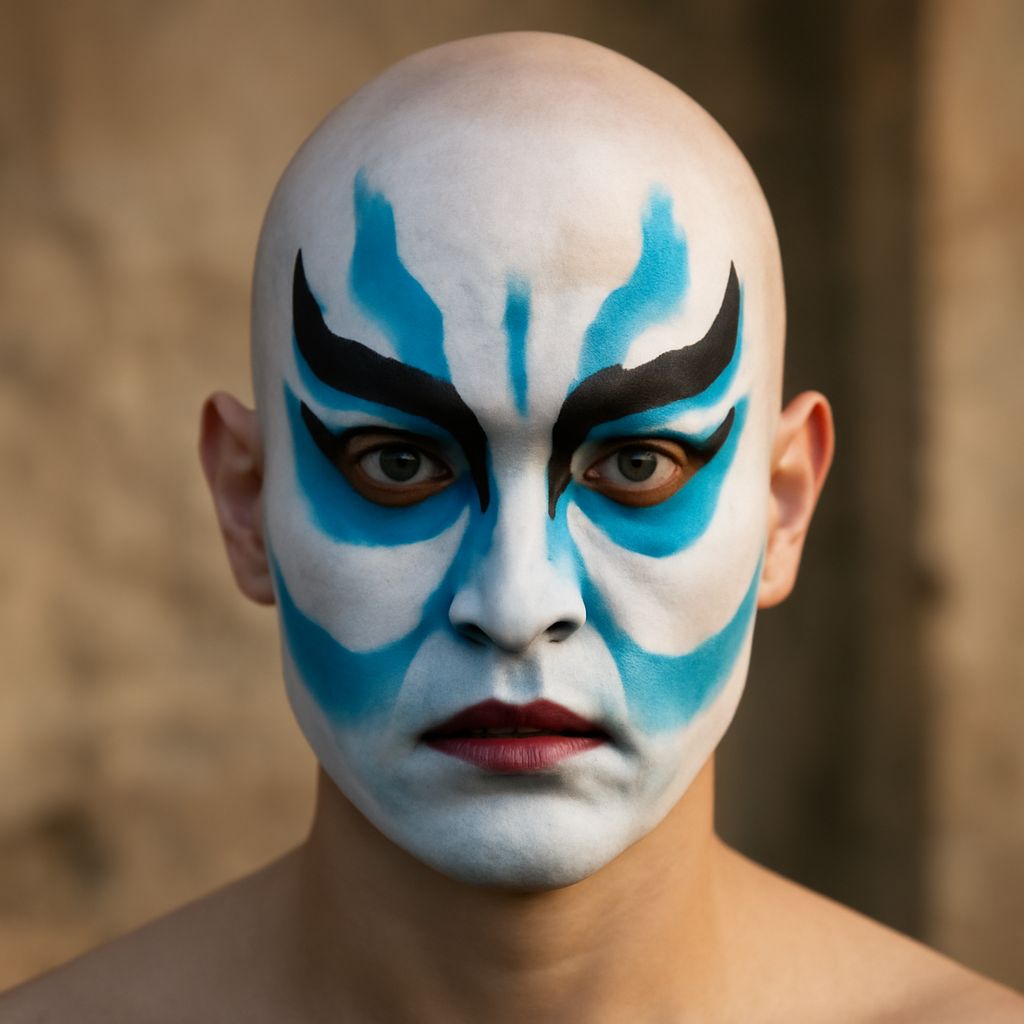
Kumadori makeup is a highly stylized face design associated especially with dramatic historical and supernatural roles. It usually places colored lines over a pale base, following the eyebrows, cheeks, nose, and jaw. These lines visually extend the actor’s facial muscles, making anger, strength, or strain legible from a distance.
Color and pattern suggest character type, although meanings vary by role and production. Red commonly supports heroic energy, courage, or powerful vitality. Blue or indigo can suggest an enemy, a cold temperament, or supernatural force. Brown and other darker tones may serve earthy, monstrous, or nonhuman figures.
Not every Kabuki role uses kumadori. More naturalistic makeup or subtler designs may suit other characters and performance styles.
Reading Pose, Role and Makeup as One Character Image
Start with the mie: ask what the stance, gaze, and timing make the character feel at that instant. Then identify whether the movement belongs to an onnagata convention, an exaggerated male style, a comic role, or another performance tradition.
Finally, follow the painted lines. A broad red pattern that emphasizes the brows and jaw can turn a strong stance into a heroic or superhuman image. A female role may rely more on silhouette, gesture, and expression than on kumadori. Together, these choices show how Kabuki coordinates the actor’s body, role tradition, and face paint rather than treating them as separate effects.