Two separate trouser legs can create the sweep of a skirt when their fabric opens into a wide flare. In this South Asian ensemble, that movement is balanced by a tunic and often a long scarf. A set of flared trousers, a coordinating top, and a dupatta can be simple enough for a daytime gathering or richly decorated for a celebration.
Sharara Suit: The Three-Part Silhouette
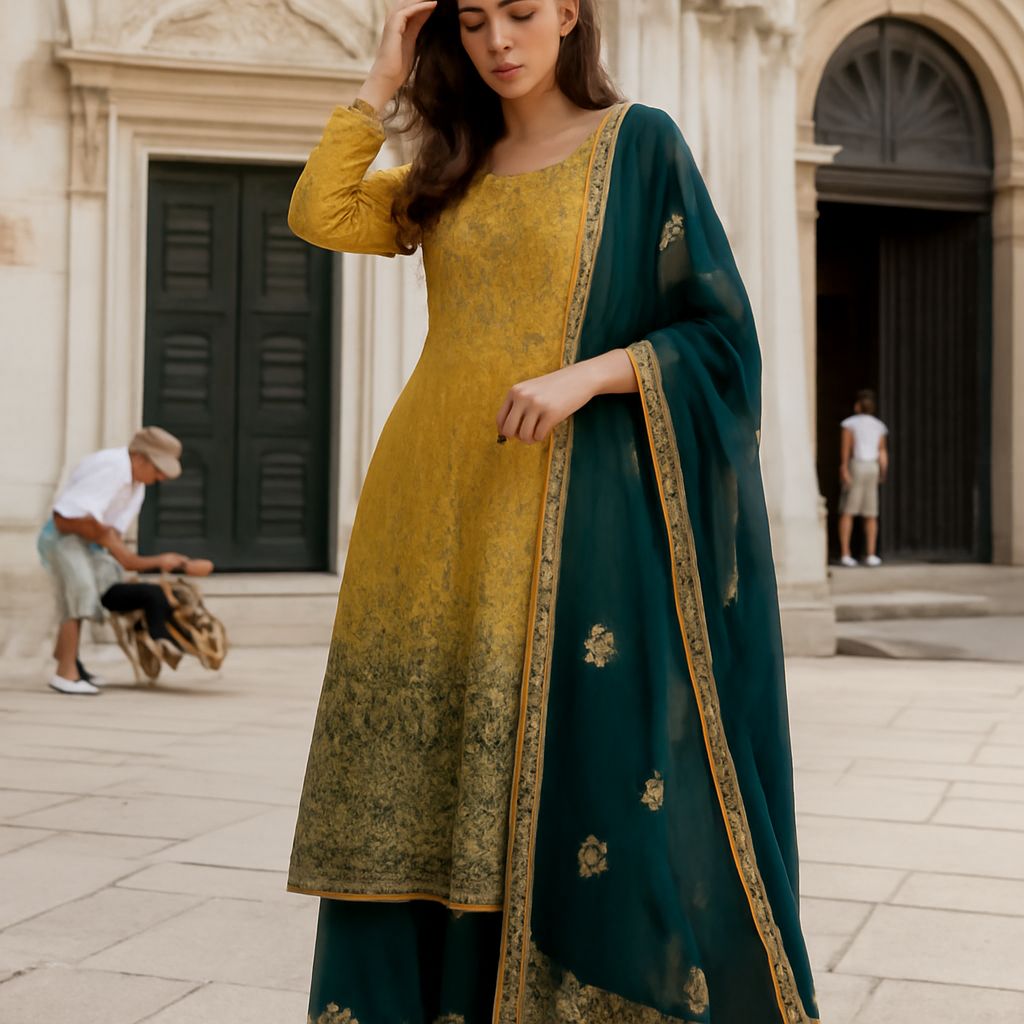
A sharara suit commonly combines flared trousers with a kurta, a tunic that can be short or long, and a dupatta, a long scarf draped over the shoulders or head. The trousers may be cut with panels that add fullness from the upper leg downward. The result can look skirt-like when standing still, but the separate legs become clear in motion.
The length of the kurta changes how much of the flare is visible. A short top reveals the trousers from the hip, emphasizing their movement; a longer top can create a continuous line before the fabric opens below it. A dupatta adds another plane of color or ornament. It may match the top, repeat the border on the trousers, or introduce a contrasting shade.
Retailers sometimes use the phrase sharara dress for an outfit sold as a set. The name alone does not establish that it is a one-piece dress. Read the component list and photographs: some sets include a top, trousers, and scarf, while others sell pieces separately. Check whether a lining is included, especially when the outer material is sheer.
Compare a Related Lucknow Garment
The Lucknow garment called a gharara also has two wide lower sections, but a common construction gathers or joins the flare around the knee. The Lucknow Bioscope exhibition documents examples worn with kurtas, including a silk top dated 1940 with smocking and metallic embellishment. Its photographs and captions show how individual garments and family histories connect to a particular city.
That example is a useful comparison for a flared-trouser outfit, not a claim that the two names are interchangeable everywhere. Contemporary sellers do not always use garment labels consistently. Look for the seam, the point where fullness begins, and the actual component list when distinguishing a knee-joined flare from a more continuous one.
The exhibition records ghararas as both earlier everyday clothing and later wedding and party wear. Occasion changes materials and decoration as well as the way an outfit is presented. A photograph of one historical Lucknow ensemble should therefore be read alongside its caption rather than taken as a fixed pattern for the whole region.
See Two Contemporary Festive Examples
Label Revati Palshetkar’s beige set lists a short kurta, flared pants, and an embroidered dupatta for contemporary celebrations. The maker specifies viscose raw silk for the top and pants and viscose organza for the scarf, with silver-colored embroidery and cut-bead accents. The translucent scarf and more substantial fabric below provide different visual weights within one coordinated outfit.
For another festive interpretation, Nandita Thirani’s ivory ensemble combines an overlapping kurta, embroidered flared trousers, and a pistachio dupatta. The designer lists georgette for the top, satin tissue and taffeta for the pants, and chiffon for the scarf. Pearl work and embroidery contribute to its formal appearance. These are named contemporary designs; they illustrate choices available for an event rather than prescribing one regional costume.
Choose Fabric and Decoration for the Event
Cotton can give a daytime trouser set a lighter, more matte appearance. Georgette and chiffon are lightweight fabrics that fall in softer folds, while organza has a sheer appearance and can hold a more pronounced shape. Silk and silk-like fabrics vary widely in weight and sheen, so a swatch or close inspection is more informative than the fiber name alone. Lining also affects opacity, warmth, and how the trousers fall.
Decoration has both visual and practical weight. Zardozi refers to metal-thread embroidery; beads, sequins, and border trims can add sparkle around the neckline, hem, or scarf edge. A heavily worked hem may pull the flare downward, producing a different movement from an untrimmed edge. For a seated dinner or an event involving dancing, consider the weight against the length of time the outfit will be worn.
A daytime family gathering may call for a printed cotton top, lightly flared trousers, and a modest border. A wedding guest might choose a richer fabric and coordinated embroidery, taking cues from the invitation and hosts. Both are examples of styling a flared set; the wearer can adjust color, coverage, and decoration to the occasion.
Assemble and Fit One Complete Look
For a festive evening, begin with deep teal flared trousers and a hip-length teal kurta in a fabric with a soft sheen. Add a lighter teal or antique-gold dupatta with a narrow embroidered edge, then choose small gold-toned earrings and low, secure shoes. The scarf picks up the warm detail while the matching top and pants allow the volume of the legs to remain the focus.
Put the shoes on before checking the hem. Each leg should clear the floor when walking and climbing a step; a tailor can shorten the trousers while preserving or reattaching a decorative border. The waistband should stay in position when sitting without cutting in, and the hips and thighs need room to move before the flare begins. If the top has side slits, check that they open comfortably over the trousers.
Drape the dupatta over both shoulders or across one shoulder and secure it discreetly if needed. Move the arms, sit, and walk in the full sharara suit: the scarf should stay where intended, the trouser hems should clear the shoes, and the top should remain comfortable. Finally, compare the color and weight of every piece with the chosen event so the complete set feels coherent.