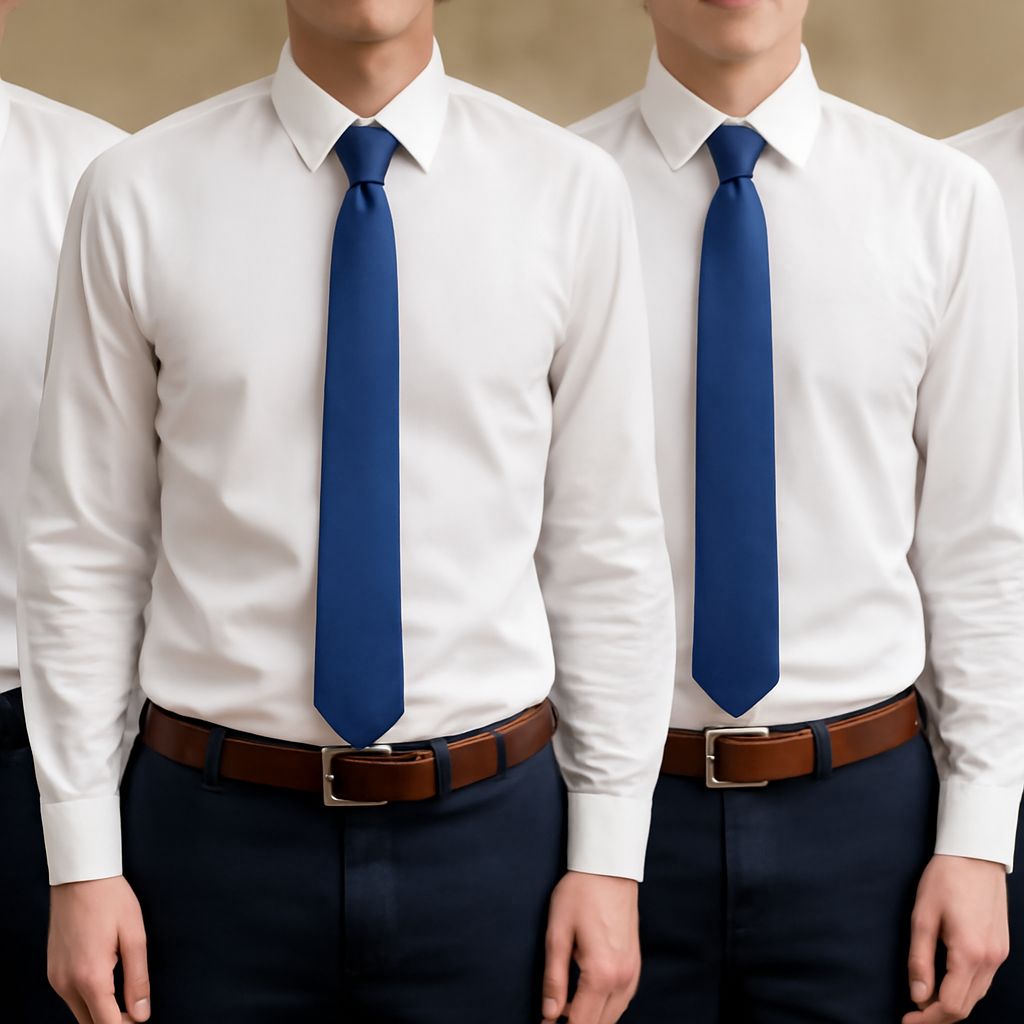
A necktie may measure 58 inches laid flat, yet its visible front is much shorter once it passes around the neck and through a knot. The useful question is how long a tie should be on the wearer: the conventional answer is for the wide tip to reach the belt buckle or waistband. Where the tie should end depends on where the trousers sit as well as on the length of the fabric.
That distinction matters when shopping. The measurement on a label describes the entire untied tie, from tip to tip. The finished position depends on how much material the neck, knot, and back blade use. Height is a useful starting point, but it cannot give the whole answer.
Where Should Tie End for a Balanced Look?
With a tucked-in shirt and belted trousers, aim for the wide front tip to fall around the top to the middle of the buckle. Without a belt, use the waistband as the reference. Stand naturally and check the result in a mirror.
This is a convention for a classic outfit, not a limit on creative styling. A deliberately cropped tie or an unusually low tip can be part of a chosen silhouette. For a first fitting, however, the waistband provides a consistent landmark. If a vest covers the tie, check that the tip remains hidden beneath it rather than peeking out at the hem.
Where should tie end when the trousers have a higher rise? The reference moves upward with the waistband. The same tie, knot, and wearer may need a different starting position when changing from low-rise trousers to high-waisted ones.
Choose an untied length to try
Many standard ties are approximately 57 to 59 inches long; extra-long models are often around 61 to 63 inches. These are common product ranges rather than universal sizes. Manufacturers vary, so check the actual measurement instead of relying only on a label such as “regular” or “long.” The Tie Bar’s sizing advice gives 57–58 and 61–63 inches as useful examples.
A tie length guide can offer a starting point, but the fitting test decides whether that particular tie works. A person around 5 feet 8 inches tall might begin with a 58-inch tie and a four-in-hand knot, a compact knot made with a single wrap. Someone around 6 feet 2 inches might try a 62-inch tie, especially with a longer torso or a larger knot. Neither example is a prescription: try the tie with the actual shirt and trousers.
The phrase “mens tie length” may appear on a retailer’s size page, but the useful measurements apply to anyone wearing a necktie. A buyer can compare the listed length with a tie that already fits, regardless of the category in which either item is sold.
Why height alone does not settle the fit
Using tie length by height is a shortcut because taller people often have more distance from collar to waistband. But two people of the same height can have different torso lengths. The person with a longer torso may need more fabric to reach the same point, while the person with longer legs may find a standard tie sufficient.
Neck size, chest, and midsection also affect the route the fabric takes. A broader neck uses more material around the collar, while a fuller chest or midsection can make the front blade travel farther. Trouser rise changes the destination. A high waistband shortens the distance from collar to tip; a low one lengthens it.
Consider two people who are both 6 feet tall. One wears high-rise trousers and a compact knot, and a 58-inch tie reaches the waistband comfortably. The other has a longer torso, wears lower-rise trousers, and prefers a full Windsor, a larger knot with additional wraps. That person may need an extra-long tie. The exact result still depends on the tie and how it is tied.
Allow for the knot and both blades
The wide end, or front blade, is the visible section; the narrow end, or back blade, hangs behind it. The fabric consumed by the knot and neck loop is no longer available to either blade. A four-in-hand generally uses less material than a full Windsor, so switching to the smaller knot can bring a short front blade closer to the waistband.
How long should a necktie be if the narrow end hangs below the wide end? First retie it, starting with the wide end lower and the narrow end higher. If the front reaches the waistband but the back remains awkwardly long, a shorter tie or a larger knot may help. If the front is too short and the back is already very short, try a longer tie rather than pulling the knot loose.
A keeper loop is the small loop on the back of many ties that can hold the narrow blade in place. It helps keep the blades together, but it does not add fabric or correct a tie that is too short.
Test before buying another size
For a useful necktie length check, put on the intended shirt and trousers and tie the knot normally. Look at the front tip, then inspect the narrow blade. If the front hangs too low, start it a little higher before tying; if it stops too high, start it lower. Retie and check again, since changing the starting point also changes the back blade.
How long should tie be for the outfit? The answer is the length that lets the preferred knot sit comfortably while the front tip reaches the intended landmark. Different tie lengths can produce the same finished position when their knots and starting positions differ, so compare fit on the body rather than by the label alone.
If a properly tied sample still misses the waistband after a sensible adjustment of both blades, choose the next length that corrects the fit with the knot and trousers intended for wear.