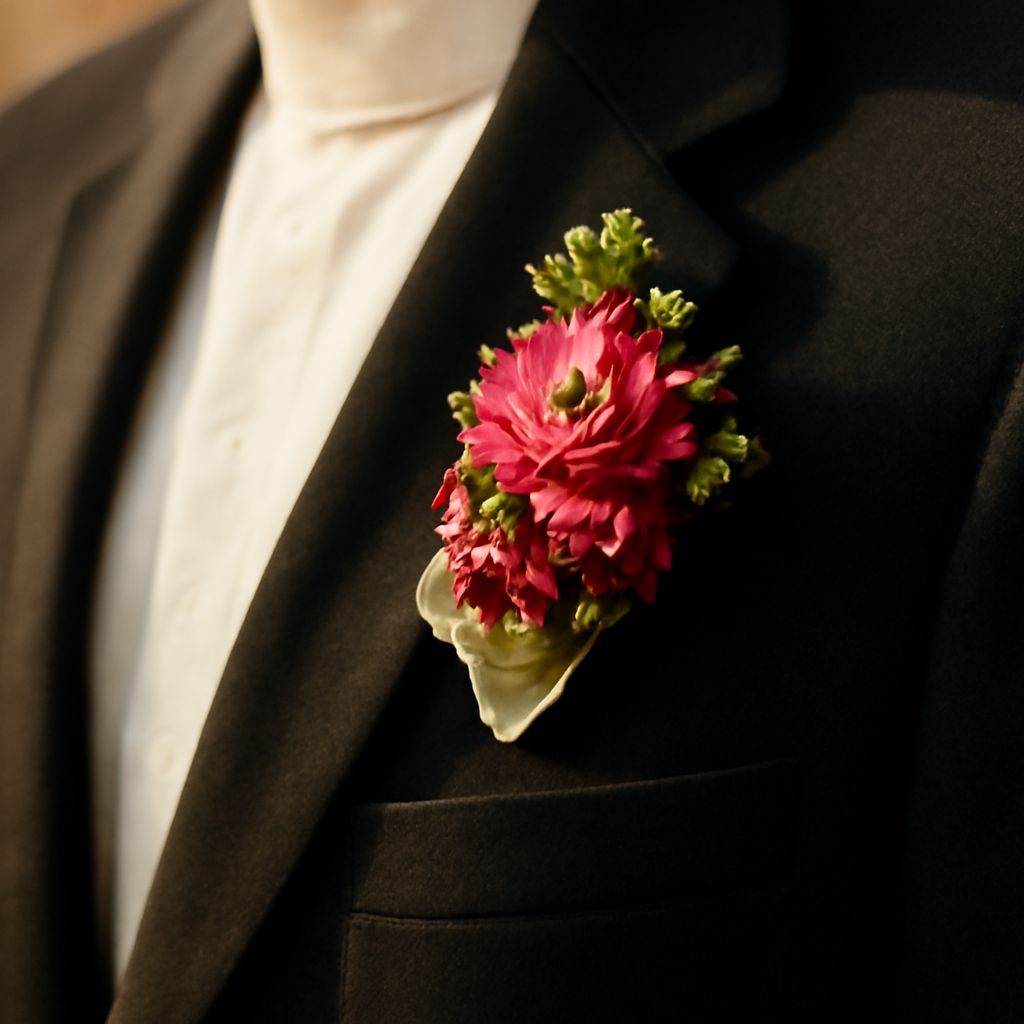
A boutonniere is a small floral arrangement worn on clothing, often for a wedding, formal gathering, or performance. Pinning a boutonniere neatly begins with choosing a firm place for its stem; putting a boutonniere on with a pin then secures the arrangement without leaving a sharp point against the wearer.
The flower should face outward, with the stem pointing down and the fastening hidden behind the fabric. A mirror helps establish the position, while a second person can make the actual pinning easier. To pin a boutonniere in place, the fabric needs enough body to carry its weight. The principles apply across formal styles.
Choose a position and prepare the materials
On a jacket with a lapel, the customary position is high on the left lapel, near its buttonhole. Place the flower head just below the widest part of the lapel, with the stem roughly parallel to its outer edge. The arrangement should sit above the pocket square rather than compete with it. A different position can suit a costume or event styling plan.
Before deciding how to pin a boutonniere, hold it in place and check the view from the front. The bloom should be visible without touching the chin, collar, or shoulder when the wearer moves. A small, lightweight arrangement is easier to support than a large one, especially on fine fabric. Keep the florist’s wrapping around the stem intact: it protects the clothing and gives the pin something to grip.
For pinning the boutonniere to a lapel, use a long florist’s pin with a secure head. Have a second pin available for a heavy or top-heavy arrangement. Avoid forcing a thick pin through delicate silk, leather, or a heavily embellished surface; ask the florist about a clip or another attachment suited to the garment. Test any puncture method on a discreet seam allowance first, with the wearer’s permission.
How to pin on a boutonniere: the lapel method
Knowing how to pin on a boutonniere starts with catching both the fabric and the wrapped stem. Lay the lapel flat and hold the flower where it will be worn. Lift the lapel away from the body so the point cannot reach the skin, and keep fingers clear of the pin’s path.
- From the back of the lapel, push the pin through the fabric toward the front, close to the stem’s upper half. The pinhead remains behind the lapel.
- Pass the point through the wrapped stem, keeping the flower facing outward. Aim across the stem rather than straight down its length so the pin has a firm hold.
- Guide the point back through the lapel to the reverse side. The pin should form a shallow stitch through fabric, stem, and fabric, with both the head and point behind the lapel.
- Check that the point is fully through and directed away from the body. If it protrudes toward the wearer or catches on a lining, withdraw it and repeat the stitch at a safer angle.
To see how to pin a boutonniere securely, look at the back as well as the front: the cloth must support the stem, and the point must stay clear of skin. When pinning the boutonniere through its wrapped stem, keep the pin close to the fabric without puckering it. Pinning a boutonniere securely on a lapel also means checking whether a gentle touch makes the flower turn around the first stitch.
Knowing how to pin on a boutonniere securely matters most when the flower is heavy. If it swivels, add a pin lower on the wrapped stem, following the same back-to-front-to-back route. Keep the two pins separated enough to support the arrangement without crushing it. Pinning a boutonniere on a jacket works best when the lapel hangs naturally during the final check; a stretched lapel can shift once released.
Working without a conventional lapel
A waistcoat, structured dress, or jacket with a firm upper edge can provide a stable place for a flower. Position it high on the left side of the chest, away from straps and areas that bend sharply. To pin a boutonniere on a garment without a lapel, lift the outer fabric away from the body and use the same short stitch through the wrapped stem. Check the reverse side before the garment is worn if the inside is difficult to reach safely.
Consider how to attach a boutonniere when the fabric is sheer, loosely woven, or too delicate to puncture. Attaching the boutonniere to delicate fabric calls for a support that will not tear it. A florist-supplied clip may grip a reinforced edge or a strap, provided it cannot slip or pinch the wearer. A magnetic holder is another option: place its two parts on opposite sides of the fabric and test the hold with the flower’s weight. Magnets require care around implanted medical devices. The American Heart Association advises keeping magnets at least six inches from an implanted pacemaker or defibrillator; follow the device manufacturer’s guidance and choose a clip if a magnet is unsuitable.
For a pocketed outfit, a small pocket insert or a florist’s pocket holder can support the stems without piercing the cloth. The flower should rise without pulling the pocket open. Attach the boutonniere to its holder as the florist directs, then place the holder in the pocket and test it while walking. These alternatives also avoid pinholes in a rented or fragile garment.
Check the arrangement in motion
After attaching a boutonniere, let the wearer stand, turn, and raise an arm gently. Look for a flower head that tips outward, a stem that slides down, or fabric that gathers around the fastening. If the garment shifts against a seat belt, bag strap, or jacket closure, move the arrangement to a clear area before the event.
The most likely problem is a flower that slowly droops because its stem can rotate around a single pin. If the head tilts away from its original position, support the flower, lift the fabric away from the body, and add a second stitch lower down; then check again that both points are safely behind the fabric.