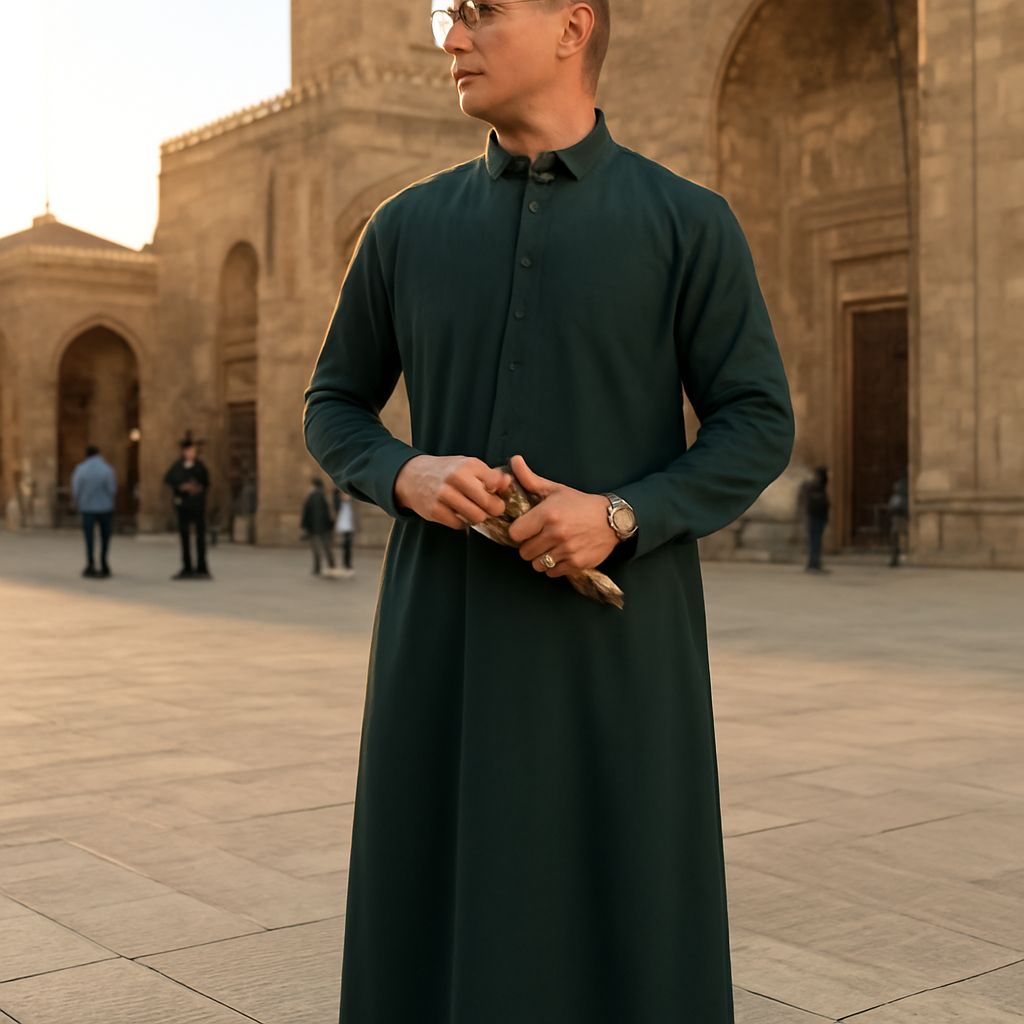
Clothing in Saudi Arabia can convey a great deal through the shape of a sleeve, the weight of a cloak, or the way a headcloth is folded. A closely tailored white thobe and an embroidered dress with wide sleeves belong to different sartorial traditions, yet both invite attention to construction as well as appearance.
The dress of Saudi Arabia changes with place, occasion, and individual preference. Historical regional ensembles sit alongside contemporary tailoring and international fashion, while family celebrations and heritage events may bring particular garments into view. Looking at the pieces one by one makes their relationships easier to understand.
Saudi Arabian clothing and the men’s ensemble
A familiar foundation of Saudi Arabian men’s clothing is the thobe, a long, sleeved garment typically reaching the ankles. Its clean vertical line can look spare from a distance, but collar shape, cuff treatment, fit, and fabric give a tailor room to distinguish one garment from another.
A white thobe may be paired with a ghutra, a headcloth, and an agal, a black cord that holds it in place. A red-and-white checked headcloth is often called a shemagh. Folded and draped around the head and shoulders, the cloth adds a broad plane of pattern above the uninterrupted length of the thobe. The Jockey Club of Saudi Arabia includes a thobe with a bisht, agal, and ghutra or shemagh among its suggested combinations for a formal event.
Saudi clothing can also acquire a more ceremonial character through an outer layer. A bisht is a cloak worn over the thobe; its open front reveals the garment beneath, while trim draws the eye along its edges. The Saudi Press Agency’s account of bisht weaving describes camel hair as a material used in this craft. At a wedding or formal celebration, the cloak can add a sense of occasion without obscuring the underlying ensemble.
This ensemble is one important expression of Saudi Arabian clothing and of men’s attire in Saudi Arabia. The fabric’s weight, the cut of the thobe, the presence of a cloak, and the arrangement of the headcloth can all change the effect. A person may choose a simple combination for an ordinary day and a more elaborate one for a gathering, depending on the event and personal taste.
Regional garments and historic details
Saudi Arabian dress traditions extend well beyond a single silhouette. Saudipedia’s overview of Founding Day describes historical eastern-region combinations such as a ghutra secured with an agal, a dishdasha, and sometimes an outer bisht or dagla. Its western-region account lists a thobe, shemagh, agal, vest, and bisht. These historical examples offer a way to compare components rather than a census of what everyone in each region wears today.
A survey of women’s garments describes the central-region maqta as a long, wide garment with generous sleeves, and a sheer embroidered over-gown known by several names, including al-Nashl. Its western-region account describes the masdah as a loose garment assembled from five pieces. Embroidery concentrates attention on particular areas of cloth, while cut affects how fabric falls. Such names point to specific traditions and designs rather than interchangeable labels for every long dress.
The breadth of clothing from Saudi Arabia is also visible in accessories. The Metropolitan Museum of Art holds a nineteenth-century silver neck ornament attributed to Saudi Arabia or Yemen. The museum explains that similar heavy necklaces formed part of jewelry ensembles worn by Bedouin women, and that jewelry could form part of a bride’s personal wealth. The object’s attribution spans two present-day countries, a reminder to read its geographic label as carefully as its material and form.
For an observer of Saudi clothing, this jewelry changes how an outfit can be read: silver is both a visible element of adornment and, in the museum’s account, a possession with economic meaning. The garment and the ornament belong to a social setting, not simply to a palette of colors.
Materials, movement, and modern choices
The cut of Saudi garments influences their movement. A long thobe makes a continuous line from collar to hem, whereas a broad outer cloak hangs in folds around it. On a wide-sleeved dress, the sleeve becomes especially visible as the arm moves. Embroidery, woven fabric, and metallic trim can emphasize a neckline or edge, giving structure to an otherwise flowing surface.
Contemporary Saudi fashion is shaped by the wearer as well as by inherited forms. Some people favor traditional garments in particular settings; others choose international styles, or combine familiar silhouettes with contemporary fabrics and tailoring. Color and fabric weight, comfort, work, family custom, and the formality of an invitation can all inform a choice. Saudi apparel therefore has a range of expressions even within the same city or household.
The details of men’s dress in Saudi Arabia can be read in the same way. A white thobe, checked shemagh, and agal form one recognizable combination, but the choice of headwear, cut, and accessories can vary. Adding a bisht changes the layers and the visual emphasis; leaving it off allows the thobe’s collar and cuffs to remain the dominant details. Saudi Arabian clothing offers these choices within a living field of dress rather than one fixed costume.
Imagine a guest at a wedding wearing a white thobe, a red-and-white shemagh secured with an agal, and a dark bisht with contrasting trim. The thobe supplies the long central line, the checked cloth frames the face, and the cloak gives the outfit its ceremonial layer. The setting helps explain that final choice, while the cut, drape, and selected accessories still reflect the wearer’s own preferences within the clothing traditions of Saudi Arabia.