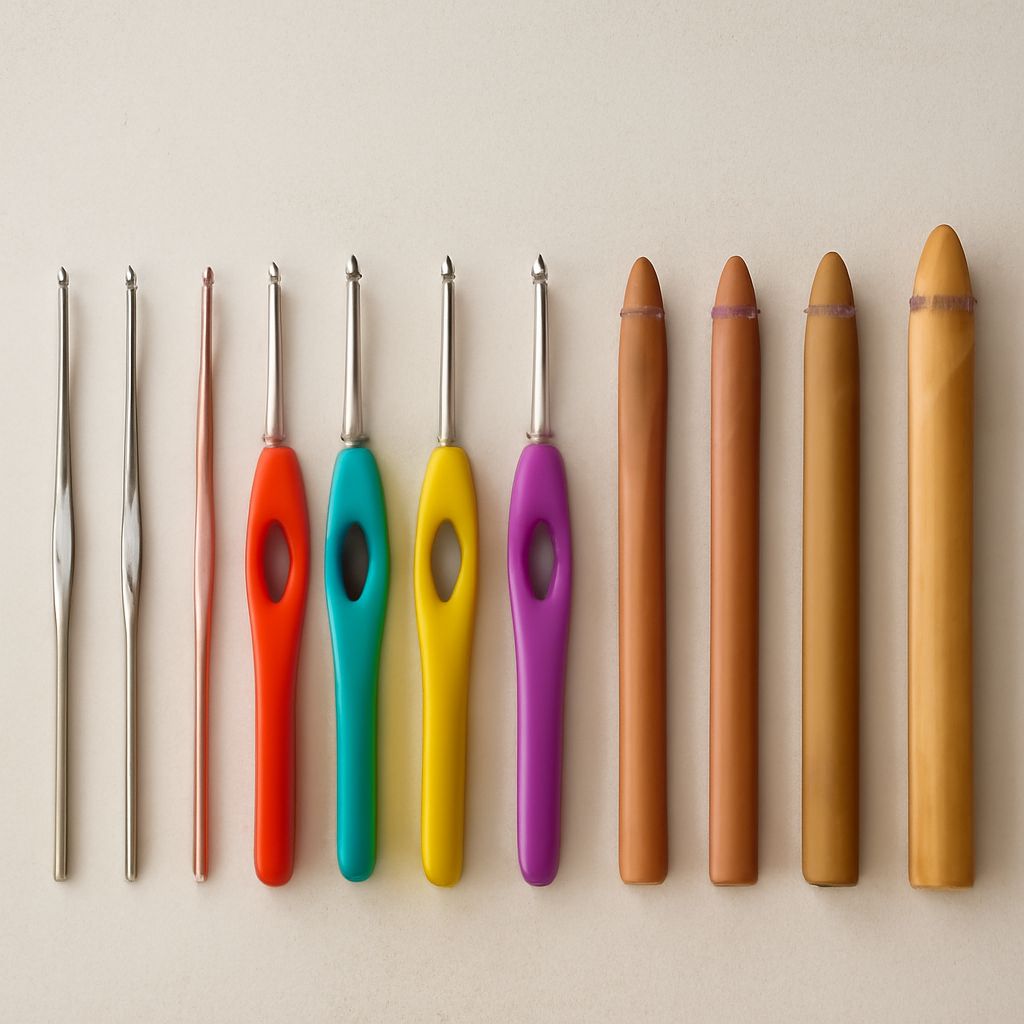
A hook marked G can measure 4.0 mm from one maker and 4.25 mm in another sizing reference. That small difference can change the size of every stitch across a garment. A conversion table for crochet hooks is therefore most useful when it identifies the millimeter measurement as well as the letter.
The size of a crochet hook refers to its working diameter, not the length of its handle. A pattern, a yarn label, and the hook itself may each display a different combination of letters and numbers. Reading those markings together provides a starting point; a measured sample of the fabric determines whether the choice works for the project.
Crochet Hook Sizes: A Practical Conversion Table
The following crochet hook size chart lists common regular hook designations from the Craft Yarn Council’s hooks and needles reference. A dash means that the council’s table does not assign a U.S. letter for that row. These hook-size comparisons are guides rather than universal conversions: manufacturers may use the same letter for different diameters.
| Diameter | Common U.S. letter | Common U.S. number |
|---|---|---|
| 2.25 mm | B | 1 |
| 2.75 mm | C | 2 |
| 3.25 mm | D | 3 |
| 3.50 mm | E | 4 |
| 3.75 mm | F | 5 |
| 4.00 mm | G | 6 |
| 4.25 mm | G | — |
| 4.50 mm | — | 7 |
| 5.00 mm | H | 8 |
| 5.25 mm | I | — |
| 5.50 mm | I | 9 |
| 5.75 mm | J | — |
| 6.00 mm | J | 10 |
| 6.50 mm | K | 10½ |
| 8.00 mm | L | 11 |
| 9.00 mm | M/N | 13 |
| 10.00 mm | N/P | 15 |
The repeated letters in this hook-size table are intentional. The council’s hook-size reference lists G at 4.0 and 4.25 mm, and I at 5.25 and 5.5 mm. If a pattern specifies only a letter, consult its designer or the manufacturer’s hook-size table before treating either measurement as definitive. If a hook has a worn marking, a hook gauge with calibrated holes can help identify its shaft diameter.
This crochet hook sizes chart separates the letter and number so that H-8, for example, can be read as one U.S. designation paired with 5.0 mm. A number on its own needs context: knitting needles and fine steel hooks have their own systems. The crochet hook chart is a guide to the regular hooks shown here, not a conversion for every tool bearing the same numeral.
Fine Steel Hooks and Other Numbering Systems
Fine steel hooks are commonly used for crochet thread and lace. Their numbered system generally runs in the opposite direction to regular hook sizing: a higher steel number corresponds to a smaller hook. The Craft Yarn Council’s steel-hook reference also shows variations: a steel size 2 is listed at both 2.25 and 2.20 mm, and size 7 appears at 1.65 mm among other designations. Check the millimeter marking on the specific tool and the source of the pattern.
Older patterns and patterns from different countries may use other labels. A bare number can mean different things in a different system, so the country, publication date, and any stated diameter matter. A vintage pattern asking for “size 6” should not be converted from a regular U.S. chart until it is clear whether the intended tool was a steel hook. Compare crochet hooks sizes in millimeters whenever both sources provide them.
Use the Pattern and Yarn Label Together
Begin with the pattern’s stated hook diameter and yarn. If it gives a letter and a millimeter value, use the millimeter value to select the tool. A yarn label may suggest a different size because its recommendation is a general guide for the yarn, while the pattern calls for a particular fabric and finished measurement. Start with the pattern’s hook and make a sample with the actual yarn.
Yarn weight describes a broad thickness category, not the weight of a finished ball. Fine yarn often pairs with a smaller hook; bulky yarn commonly uses a larger one. The Craft Yarn Council’s yarn-weight guidance gives ranges and emphasizes that they are guidelines. A lacy shawl may use a larger hook for open spaces, while a small stuffed figure may require a firm fabric that holds its filling.
A second crochet hook size chart may be helpful for an unfamiliar letter, but it cannot determine the finished fabric on its own. Fiber, yarn structure, stitch pattern, and the crocheter’s tension all affect the result. A cotton top and a soft acrylic scarf made with the same diameter may have very different drape.
Make and Measure a Gauge Swatch
Gauge is the number of stitches and rows in a stated area, often 4 inches. Work a sample larger than the measured area using the pattern’s stitch, yarn, and hook. If the pattern specifies washing or blocking, treat the swatch the same way before measuring; blocking means shaping and setting the fabric as directed, often after wetting it. Lay it flat without stretching and count stitches and rows within the stated span.
For example, if a pattern calls for 16 stitches in 4 inches and the sample has 18, the stitches are smaller than intended. Try a larger hook and make another sample. If there are 14 stitches in the same width, try a smaller hook. Count rows separately: matching stitch width does not automatically match height, and the pattern may need adjustment if the row count differs.
A garment’s fit makes this step especially important. Even a small difference repeated across the chest or waist can alter the finished measurement. A scarf may tolerate a different width, but the result can still change yarn use and drape. Record the hook diameter, yarn, stitch, and measured result so the test can be repeated.
Read the pattern’s system, identify the millimeter diameter, and use the hook-diameter conversion table to interpret any letter or number. Then work and measure a swatch in the intended yarn. Keep the hook that produces both the required gauge and a fabric suited to the project.