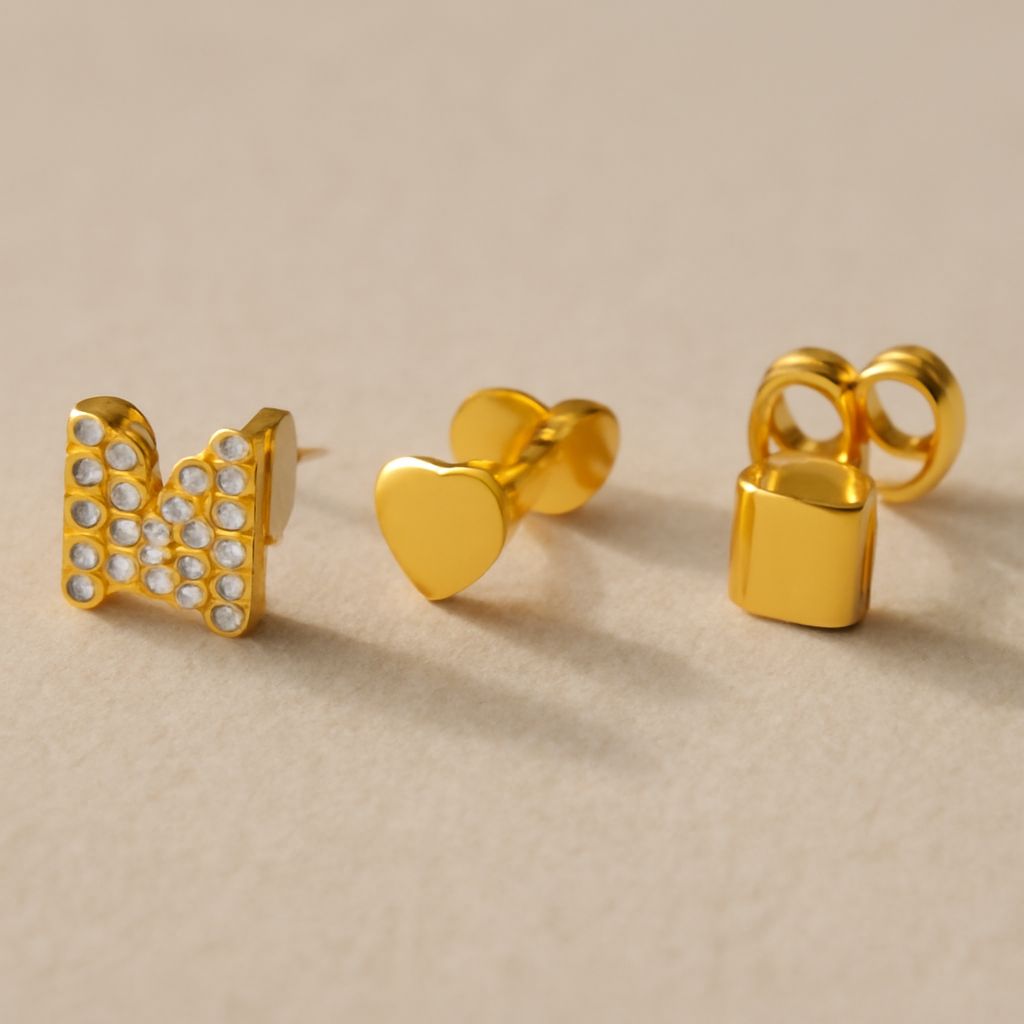
A small metal butterfly behind the ear can hold a broad jeweled stud in place, while a slender hook can carry a long, swinging drop. The visible ornament and the part that secures it perform different jobs. Recognizing how an earring closes makes it easier to judge how it will be put on, how it may feel, and whether it needs a pierced ear.
The variety of earring fastenings also affects the finished silhouette. A clasp may sit almost invisibly behind the lobe, form part of a hoop, or press against the ear without a piercing. The examples below identify each mechanism by its moving parts and show how it can serve different designs.
Earring Closure Types: Posts and Separate Backs
A post is a straight pin that passes through a piercing. On a butterfly-back stud, a separate metal clutch slides onto the post behind the ear. Its two curled sections grip the pin; a small notch on the post can help the back catch. The Gemological Institute of America describes these as friction or clutch backs as well as butterfly backs. To remove the earring, hold the front and pull the back off the post.
The front of a stud can be a tiny polished ball or a large decorative flower. Neither size identifies the fastener: look behind the lobe for the straight post and separate clutch. A back pushed too close can pinch, while one that slides too freely may need attention from a jeweler. Leave enough room for the lobe to sit comfortably and check that the back grips the post.
A screw-back stud also uses a straight post, but its matching back turns onto a threaded section. It takes more time to fasten than a push-on clutch and requires the back to match the post. When comparing types of earring closures, a threaded post and a back that rotates into place are the distinguishing details. Align the parts gently before turning; resistance at an angle can indicate that they are not properly engaged.
Hooks and Hinged Backs
Among the different earring fastening styles, a fishhook drop hangs from a curved wire that passes through a piercing and rests behind the lobe. The decorative drop is attached below the curve and can move as the wearer turns. Some hooks are worn open; a small compatible stopper can be added behind the ear to reduce the chance of the wire slipping out. A long drop is a design choice, not evidence that the hook is hinged or locked.
On a leverback drop, the curved wire passes through the piercing and a hinged piece swings up behind it to close the opening. The wearer opens that lever, inserts the wire, and closes it until the parts meet. Among earring clasp types, this one is recognizable by the movable back attached to the earring itself. Check that the lever closes without catching hair and that the curve has room around the lobe.
Another earring clasp design is the latch-back hoop, which uses a hinged arrangement: a thin post passes through the piercing and meets a catch on the other side of the hoop. Opening the catch separates the post from its holder; closing it completes the outline. A small hoop close to the ear and a wide circle can use the same mechanism. The diameter describes the visible shape, while the post and catch describe how it fastens.
A hinged clicker or huggie hoop may instead have a small segment or post that pivots and clicks into the opposite end. The joint and seam can be subtle, so inspect the hoop before applying pressure. Open it at the intended hinge and press the parts together in alignment. A close-fitting hoop needs enough internal space for the lobe; a larger outer diameter alone does not reveal that clearance.
Closures Without a Piercing
Among the different earring closure styles, a hinged clip-on holds the lobe between a decorative front and a hinged pad at the back. The wearer opens the clip, positions the lobe between the two surfaces, and closes it. A screw-back clip uses an adjustable screw to change the pressure against the back of the lobe; some designs combine a screw with a hinged clip for easier placement. These fittings can support a small button or a conspicuous drop without a pierced ear.
The two types of earring clasps distribute pressure differently depending on the pad and the individual lobe. A broad contact surface can feel different from a small one even when the ornaments look alike. The right setting holds the piece in place without painful squeezing. If a clip hurts, remove it and have its fit adjusted by someone familiar with the mechanism rather than forcing a rigid part.
Compare the Whole Earring
Comparing earring closure types is only one part of the decision. Weight, balance, contact area, and the length of a drop all affect comfort. A large ornament made from light material may pull less than a small, dense one; a long piece may brush a collar, wig, or mask strap. Move the head gently while trying it on and notice whether the earring twists or catches.
Material also matters where the fitting touches the skin. A reader with a known metal sensitivity can check the composition of the post, back, or clip as well as the decorative front. If a fastening is loose or damaged, a jeweler can assess the fitting and suggest a compatible repair or replacement.
For a compact identification check of earring fastening types, look for a straight post and removable back, a threaded post, an open curved wire, a hinged lever, a hoop catch, or a pad that presses the lobe. Then compare the fastening style with the ornament’s size and weight, the available clearance, and the time needed to put it on. Those details connect the mechanism to the comfort and visual effect of the complete piece.